
By Fabian Ekeruche
Taraba State has budgeted ₦2.6 billion for capital expenditure by its Primary Health Care Development Agency (PHCDA) in 2026), but available budget-performance records reviewed in September show that none of the allocation had been recorded as spent at the half-year point.
The figure is separate from the state’s overall 2026 allocation of ₦25.716 billion to the Ministry of Health, published on the Taraba State Budget Transparency Portal.

The difference between the overall health allocation and the PHCDA capital provision is important because primary healthcare interventions in the state are funded through several channels, including the state government, Federal Government agencies and development partners.
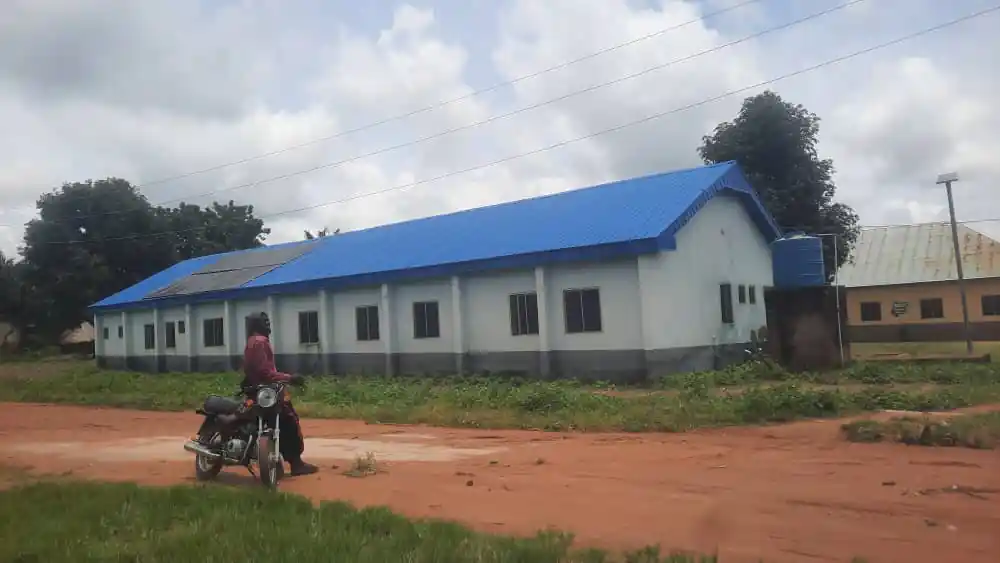
Yet, an assessment of 75 Primary Health Centres (PHCs) across 15 Local Government Areas (LGAs) has documented extensive deficiencies in facilities that communities depend on for basic healthcare.
The assessment by Orodata Science found that 72 per cent of the PHCs had broken ceilings, 63 per cent had leaking roofs and 73 per cent had damaged furniture.
It also found that 36 per cent had no electricity, while 37 per cent relied on unsafe water sources.
Only 40 per cent had perimeter fencing, while 63 per cent had no accessibility features for persons with disabilities and people with mobility difficulties.
The overall system score was 46 per cent, classified as poor.
The figures provide a facility-level benchmark against which public spending on primary healthcare can be examined.
The state allocation
Taraba’s 2026 budget provides ₦25.716 billion for the Ministry of Health, according to the state government’s Budget Transparency Portal.
The portal lists total state expenditure for 2026 at ₦653.63 billion and capital expenditure at ₦460.39 billion across 1,630 projects.
However, the ₦25.716 billion is the Ministry of Health’s total allocation and should not be presented as money exclusively earmarked for PHCs.
Budget-performance records reviewed by other investigators show that the PHCDA’s capital allocation for 2026 is ₦2.6 billion.
The same records indicate that, at the half-year point, no expenditure had been recorded against the ₦2.6 billion capital provision.
The position contrasts with the condition of many of the facilities assessed by Orodata.
The assessment found that maternal and newborn readiness stood at only 38 per cent.
Although 75 per cent of the facilities had delivery beds, only 21 per cent had neonatal equipment, 20 per cent had infusion pumps and 36 per cent had fetal monitors.
The evidence establishes the size of the budget provision and the physical condition recorded at the surveyed facilities. It does not, however, establish that the ₦2.6 billion was intended to renovate all 75 facilities assessed by Orodata.
What happened in 2025?
The 2026 allocation follows a similar pattern recorded in the previous financial year.
Available budget-performance records show that Taraba budgeted ₦2.8 billion for PHCDA capital expenditure in 2025, but actual expenditure was reported at about ₦139 million for the year.
That represents a small proportion of the capital provision.
The state’s broader 2025 health budget records also showed a substantial difference between allocation and recorded expenditure.
For primary healthcare programmes, the final allocation was reported at ₦16.34 billion, while actual expenditure was ₦1.67 billion, representing 10.2 per cent.
Within that programme, ₦12.38 billion was allocated for the provision of adequate and modern health infrastructure, against reported expenditure of ₦74.16 million, or 0.6 per cent.
These figures do not by themselves explain why the allocations were not fully spent.
They do, however, provide documented evidence of a recurring difference between budget provision and recorded expenditure.
Three streams of PHC investment
The financial picture becomes more complex because state funding is only one source of PHC investment in Taraba.
Dr Tukura Nuhu, Executive Secretary of the Taraba State Primary Health Care Development Agency, said in August that the state government had revitalised 113 PHCs under the IMPACT Project, with one facility located in each ward.
He also said three additional PHCs had been revitalised by the National Primary Health Care Development Agency (NPHCDA), with one in each senatorial zone.
Nuhu further disclosed that 13 PHCs were being upgraded from Level One to Level Two under a Global Fund-supported programme implemented by UNICEF.
These figures cannot simply be added to produce a total number of unique renovated facilities because the available public information does not establish whether any facilities occur in more than one intervention category.
They nevertheless establish that at least three identifiable intervention streams are operating in the state.
The IMPACT intervention
The 113 PHCs said to have been revitalised under IMPACT represent the largest intervention publicly identified by the state PHC agency.
The key accountability question is how the intervention corresponds with the conditions found by Orodata.
The agency’s claim that the facilities were revitalised is a verifiable government statement.
Orodata’s survey, meanwhile, provides independently collected evidence about the operational condition of 75 PHCs.
But without the names and locations of all 113 IMPACT facilities alongside Orodata’s sample, the two datasets cannot responsibly be presented as a direct comparison.
That makes the facility-level project list an important missing document for a complete audit trail.
Federal intervention
NPHCDA’s intervention provides a second source of public investment.
The Taraba PHC agency said three PHCs had been revitalised by NPHCDA, one in each senatorial district.
Again, the available statement does not identify the three facilities in the material reviewed for this report.
Consequently, their condition cannot be matched conclusively with Orodata’s 75-facility assessment.
Such matching would establish whether the federal intervention reached facilities that Orodata subsequently assessed and what condition those facilities were found in.
Global Fund and UNICEF
The third intervention involves development-partner funding.
The Taraba PHC agency said 13 facilities were being upgraded from Level One to Level Two through a Global Fund-supported programme implemented by UNICEF.
The programme is particularly relevant because the Orodata assessment found serious gaps in maternal and newborn readiness.
Only 21 per cent of the surveyed facilities had neonatal equipment, 20 per cent had infusion pumps and 36 per cent had fetal monitors.
The publicly available statement, however, does not provide sufficient facility-level information to determine whether any of those 13 facilities were among Orodata’s 75 surveyed centres or whether the equipment deficiencies identified by Orodata existed before or after the UNICEF-supported upgrades.
It would therefore be inaccurate to attribute those deficiencies to the donor-funded programme without further records.
Funding constraints acknowledged by agency
The state PHC agency itself has acknowledged funding constraints.
Nuhu identified poor budget releases and inadequate counterpart funding among the challenges affecting the agency.
He also cited accumulated electricity bills, inadequate monthly imprest and the cost of fuelling cold stores.
He appealed for timely approval and release of budgetary allocations, saying delays were contributing to poor budget performance.
He also said payment of counterpart funds was necessary to attract additional support from donor agencies and development partners.
These statements are relevant to the expenditure figures because they provide the agency’s publicly stated explanation of some operational funding difficulties.
They do not, however, explain the entire difference between budgeted and recorded expenditure.
Training and manpower
The Orodata assessment found another disparity.
While 77 per cent of PHC staff had received training, staffing compliance was recorded at zero per cent, with midwife coverage at 31 per cent.
Staff satisfaction was only 36 per cent.
The Taraba PHC agency, however, reported that the state government had employed 450 PHC personnel, including community health extension workers, medical laboratory technicians, primary healthcare technicians, midwives and community nurses.
It also said approval had been granted for 480 community-based health workers.
These figures require the same facility-level verification as infrastructure spending.
The fact that personnel have been employed at state level does not establish how many have been deployed to the 75 PHCs assessed by Orodata.
What the community receives
The available evidence therefore shows three things simultaneously.
First, Taraba has a ₦2.6 billion PHCDA capital allocation in the 2026 budget, while the broader Ministry of Health allocation is ₦25.716 billion.
Second, budget-performance records reviewed publicly indicate that no expenditure had been recorded against the PHCDA’s ₦2.6 billion capital allocation at the half-year point.
Third, Orodata’s assessment found extensive infrastructure and equipment deficiencies across 75 PHCs.
At the same time, the state reports 113 PHCs revitalised under IMPACT, three additional PHCs revitalised by NPHCDA and 13 being upgraded under a Global Fund-supported UNICEF programme.
Taraba has multiple funding streams for primary healthcare, including a ₦2.6 billion 2026 PHCDA capital provision, yet an independent assessment continues to document widespread infrastructure, equipment, energy, water and staffing gaps across sampled PHCs.
For residents, the ultimate measure of the investment is not the amount written in a budget or the number of facilities listed as revitalised.
It is whether the health centre has a sound roof, functional equipment, electricity, safe water, adequate personnel and the capacity to provide essential care when patients arrive.
That is the ground on which Taraba’s PHC spending ultimately has to be measured.
“This story was produced for the Follow the money Investigative Programme and supported by the Africa Data Hub and Orodata Science.”


