
By Ogbu-matthias, Ugonma Joy
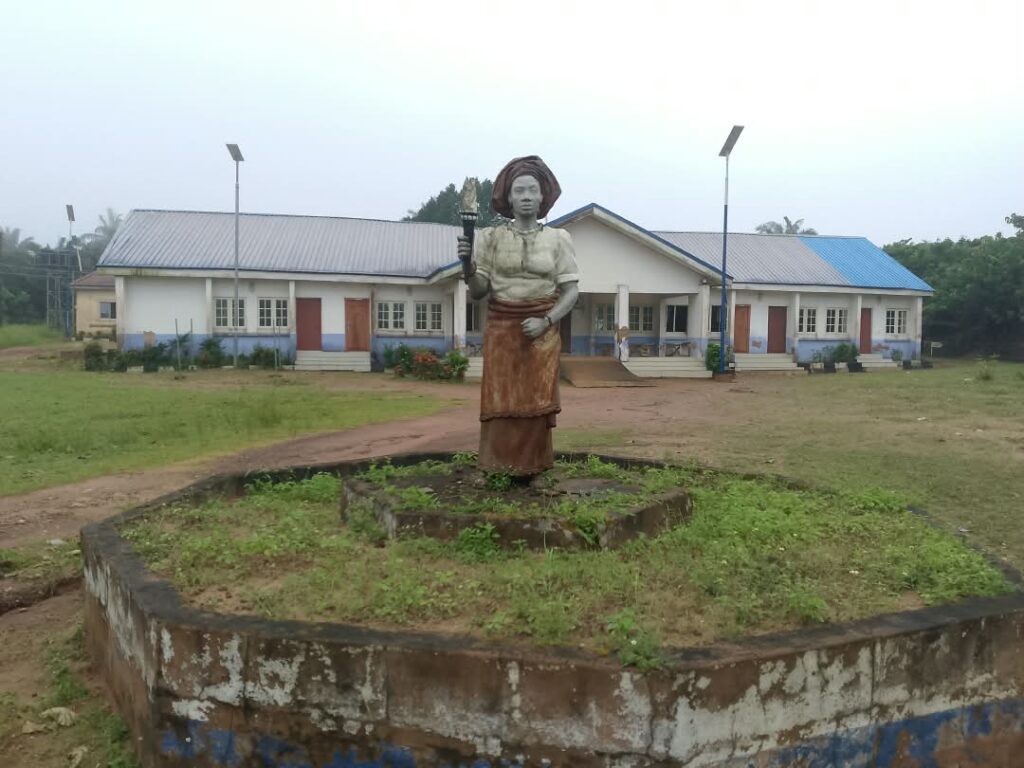
A walk into the premises of Eluama Primary Health Centre (PHC) in Isiukwuato Local Government Area of Abia State presents an unexpected and contrary picture. At the centre of the compound, a female statue, regally adorned, stood majestically, and opposite the entrance gate, a building painted white and blue sits right after the grotto with clear signage on its doorpost inscribed ‘Eluama Health Centre ’.
However, a bit of confusion hit immediately after a staff member of the facility quickly greeted me with these words, ‘This is not the Health Centre ’, accompanied by a pointed finger towards an adjacent building with no other signage or inscription besides the one on the building that is ‘not the health facility’.
This is the situation at the facility premises of the Eluama health centre, in Isiukwuato local government area of Abia State. On the left flank of the gated compound sits another building housing the actual Eluama health centre, a government-owned facility that was listed for revitalisation as part of Abia State project Ekwueme, an effort to strengthen Primary Healthcare across the state.
Field investigations by our reporter have revealed the other building to be a private health facility under a philanthropic establishment called the Sir Emmanuel Mbaka Foundation. According to public sources, the private health facility was established as a humanitarian intervention by the philanthropist, who revitalised the Eluama community health centre to provide accessible medical care like general diagnosis/treatment of common ailments, antenatal care and delivery services, alongside other primary-level healthcare services to the local population.
The foundation-run facility provides healthcare to residents at no cost, while the public PHC is part of Abia State’s primary healthcare system. With the current arrangement of shared space, other questions arose around ownership, who truly controls basic resources like land and water within the premises, how both facilities are impacting each other’s operations, and how residents/patients perceive the facilities and ultimately choose which service to use.
Furthermore, are there any agreements that govern the presence of both facilities on the same premises? Does the arrangement, in any way, affect the ability of the public PHC to provide healthcare for residents?

The Health Officer-in-charge (OIC) of the government health facility says the workers of both facilities have gone into a few brawls over access to water. According to her, the mission facility controls the water supply because it provided the borehole and installed the solar-powered system used to pump and distribute the water.
The question of who owns what at Eluama is not just about a dispute between two neighbours but could be a pointer to an unresolved decision or oversight by relevant authorities over government investments in the health facility.
The question becomes more consequential against the backdrop of the ongoing Abia State investment in primary healthcare revitalisation. According to the state e-procurement portal, the “RENOVATION OF ELUAMA PHC, IKWUATO” was listed at ₦49,421,649 with a 2024 procurement timeline.
Despite this contract listing, there is still no evidence of renovation at the public health facility, even with the recent healthcare revitalisations ongoing in the state. According to the current OIC and other local health sources, Eluama PHC was reportedly struck off the list after the facility was found deserted during repeated visits by a revitalisation review team. The team reportedly visited the facility three times before the planned intervention was moved to Umuebereaja Health Centre.

The development raises yet another question: Why was Eluama repeatedly found deserted?
The current OIC also confirms some of those problems remain as the public facility lacks reliable access to electricity, adequate toilet facilities and a dependable water source. The other facility, by contrast, had invested in its own infrastructure, including solar power, a borehole and staff accommodation, according to information obtained during the investigation.
That difference is visible within the same compound. One facility is operating with infrastructure it has provided for itself, while the public PHC continues to face gaps in basic amenities.
The resulting tension has spilt into interactions between workers and others operating on behalf of the two facilities. According to the OIC, the most recent confrontation occurred when labourers engaged to work on a staff-quarters project for the public facility attempted to fetch some water from the water source controlled by the foundation-led facility.

The entire situation points to a broader problem, where two healthcare facilities are operating within one compound, while the rules governing their shared environment remain unclear.
Meet The Private Facility
At first glance, the presence of another healthcare provider beside a public PHC might suggest competition for patients. But the reality in Eluama does not fit exactly into that narrative.
According to the facility’s representative and some residents who were interviewed, the facility operated by the Sir Emmanuel Ndubuisi Mbaka Foundation had been in operation for over a decade, providing healthcare services free of charge, at zero cost.
A resident of the community, Brother Andrew, described the foundation’s services as an important source of healthcare for the community. “You don’t know how they are helping us. Everything there is better and free, just like what the government should be doing for us,” he said.
For residents like Andrew, the question of who controls the compound may be of less importance, compared to the access and availability of the service whenever it is required.
But from the perspective of public accountability, the arrangement raises deeper questions as to how effectively two separate facilities can provide quality health care services from the same compound when the boundaries between their land, resources, infrastructure, responsibilities and ownership remain unclear.

In this instance, what happens if the public facility’s ability to expand and use its premises and basic resources has been affected by the presence of the other healthcare provider? How did this arrangement come about in the first place?
In the beginning
The history of Eluama’s health facility predates the current questions over shared space and resources. According to local accounts, the community health centre had really deteriorated, including problems with its roof and ceiling.
Community leaders and stakeholders subsequently sought ways to address the condition of the facility and approached individuals who could support its rehabilitation. One of those approached was Emmanuel Mbaka.
Local sources say Mbaka initially supported healthcare interventions in the community through medical outreaches before becoming involved in a more substantial rehabilitation of the health facility.

A 2016 report on the commissioning of the Eluama Primary Health Centre provides an important piece of that history. The report stated that the facility had been reconstructed and equipped by Emmanuel Mbaka, after which it was commissioned by the then Abia State Governor, Okezie Ikpeazu. The report also quoted Mbaka as saying the centre would provide healthcare free of charge.
This historical account makes the present arrangement even more important to understand. If a public facility that was reconstructed and equipped through philanthropic intervention was subsequently commissioned as Eluama Primary Health Centre, how did the present arrangement involving a public PHC and a foundation-run health facility both emerge within the same compound?
What was the original agreement? Who owns the land and buildings today? Who was responsible for maintaining them? And what rights, if any, were granted to the foundation-run facility over shared infrastructure? These questions can only be answered conclusively through documents and responses from the relevant authorities and parties.
A Public Investment; An unfinished Story
Following Abia State’s emergence as the best in the southeast zone for Nigeria’s Governor’s Forum Primary Healthcare Leadership Challenge Awards in the year 2025, the state clinched a prize money of 500,000 dollars. With reinforced funding for better primary healthcare delivery, the state has outpaced its other counterparts in the region by completing 182 revitalisations over the past 22 months. However, such long-standing challenges resulting from the inconsistencies in Eluama ownership can cause gaps in the revitalisation journey for Abia State.
While the government holds the prerogative for accountability and resolution on the questions surrounding Eluama Health Centre, a senior health official in the state confirmed to our reporter that a report documenting the situation involving both facilities had been filed and forwarded to the Executive Secretary of the Abia State Primary Health Care Development Agency, Kalu Ulu Kalu. Meanwhile, all efforts made via calls and messages to reach Ulu Kalu on the matter were not responded to.
While no decision has yet been taken or communicated to African Angle reporter at the time of filing this report, both facilities continue to remain on the same premises, as the private facility continues to provide free healthcare services, while the public health facility remains part of a government healthcare system that is undergoing wider revitalisation, even after seemingly losing its original chance.
At Eluama, therefore, the question is no longer simply why one health centre is struggling or which building carries the name “Eluama Health Centre.” It is now about determining the ownership and use of the public health infrastructure, the management of shared resources, the fate of public investment and the conditions under which a public Primary Health Centre is expected to function.
The central argument and questions still waiting for answers can simply be summarised thus: Who owns what, who is responsible for what, and how effectively can a public health facility function when the boundaries governing its land, infrastructure and shared resources remain unclear?
This story was produced for the Follow The Money Investigative Program and supported by Africa Data Hub and Orodata Science.


